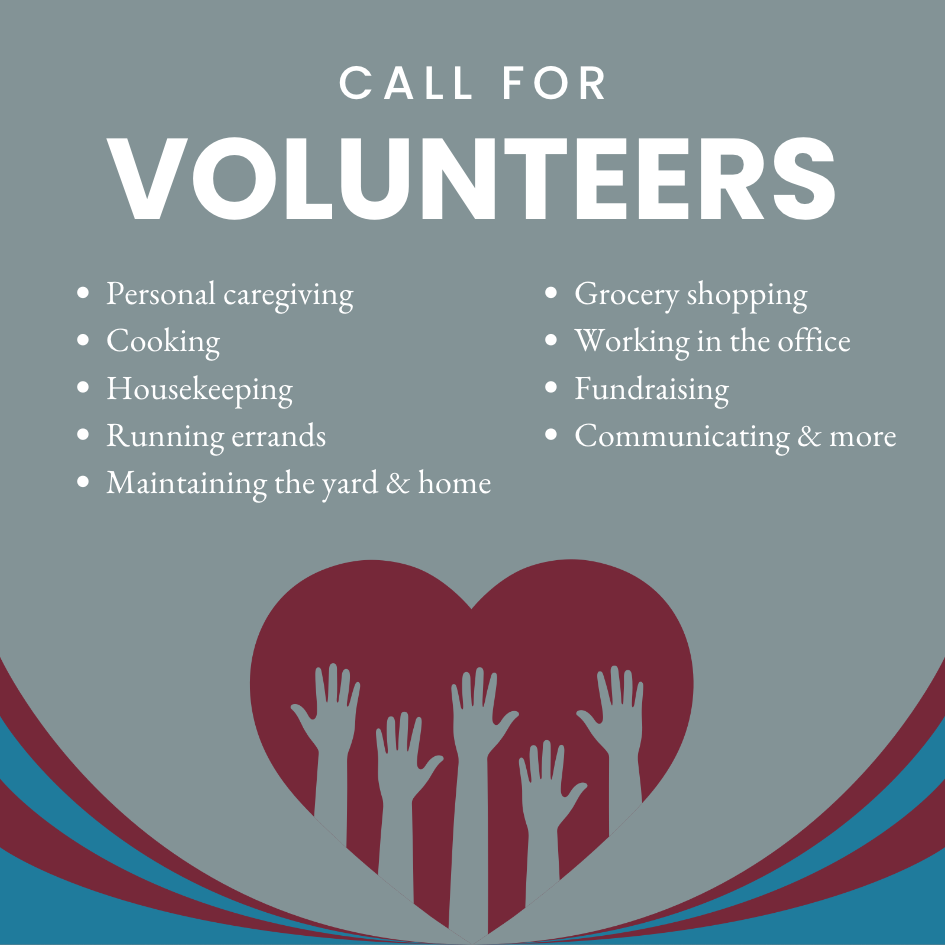
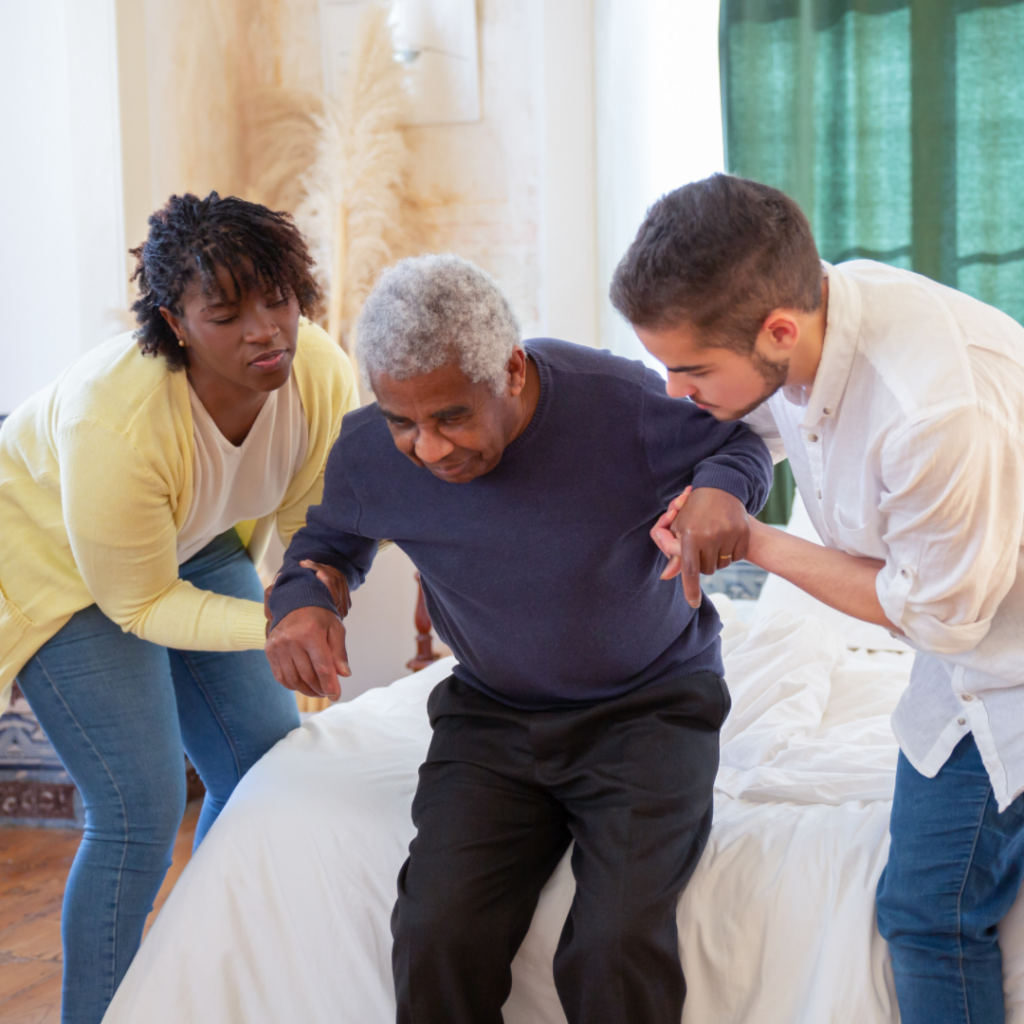
Starting and operating a home like Caring Hearts and Hands is not possible without volunteers. Both the guests and the home need help, so a volunteer’s responsibilities may include:
Personal caregiving
Cooking
Housekeeping
Maintaining the yard and home
Running errands
Grocery shopping
Working in the office
Fundraising
Communicating, and more.
Regardless of your previous experience or training, we need YOU. To learn more about how to volunteer today, you can:
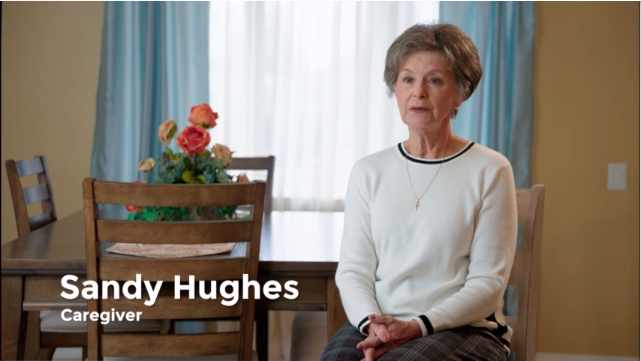
In February of 2018, Sandy Hughes of Joplin, Missouri lost her husband to cancer, sending her on a path to create a space there for a “peaceful transition from life to death.” She co-founded Solace House, a non-profit social-model home for end-of-life care. After five years of struggles and successes, Sandy is now providing encouragement and insight for the Columbia team behind Caring Hearts and Hands while still working tirelessly in Joplin to care for guests and their family members.
“I was dealing with grief from the loss of my husband, and that gave me much purpose to help start an end-of-life care home,” Sandy said. “And because of that, that starting gate, it became cathartic to me. It helped ease my grief by making sure that other people had a place to go to, because I did not. Solace House is a community of hearts. And those volunteers that come are so dedicated. They just love it. They just love what they do. Caring Hearts and Hands, it’s going to be very successful, I assure you.”
Both Solace House of the Ozarks and Caring Hearts and Hands of Columbia are part of the Omega Home Network, which provides assistance to developing and operating social-model homes across the country.
Sandy visited Columbia on March 14 for a question and answer session to help share the knowledge she and her team have earned over the past several years.
“There’s no reason for reinventing the wheel, especially if we’re going to be helping a sister city,” Sandy said. “Columbia is special. And those individuals that were there that night that I got to meet are very sincere and very passionate about what they’re trying to do. And we cheer them on; we want them to be successful.”
“Columbia is special. And those individuals that were there that night that I got to meet are very sincere and very passionate about what they’re trying to do. And we cheer them on; we want them to be successful.”
Sandy Hughes
Solace House began as Sandy gathered others in Joplin with a similar heart, as well as her husband’s oncologist, doctors, nurses, social workers and hospice providers. Within a year, the organization became an official non-profit, and by January of 2020 Sandy signed a lease for a house. They started turning this house into the perfect end-of-life home when COVID hit.
Though the pandemic certainly set them back, it also highlighted an even more intense need for a place like Solace House. With state safety guidelines, families were not allowed into nursing homes or hospitals to visit their dying loved ones. Good-byes were said through windows and phone calls. Many died alone.
So when Solace House finally opened in June of 2020, they were able to provide relief and comfort to many families. They allowed loved ones to visit and stay with their guests within the home – after COVID testing and with masks, of course.
“It was just an answered prayer for a lot of people,” Sandy said. “The timing was just incredible. Now, with that behind us, it’s been full throttle.”
The organization and others like it provide a free home for guests in their last month of life whose care needs cannot be met in their own homes, giving 24-hour support from volunteers for guests’ physical, emotional and spiritual needs. They do not replace medical care, but instead give a space for families to be around their departing loved ones in a caring and supportive environment.
“Oftentimes, when a guest comes to the house, they are exhausted from being in the hospital,” Sandy said. “When they come through those front doors, it’s as if a weight has been lifted off their shoulders. I have seen it over and over again. Solace House, it is truly transformational. I just can’t explain it any more than that. It’s just they know why we’re there. And we know why they’re there. And it’s just a matter of showing up at the house.”
With two beds in each bedroom, families are welcome to stay around the clock, doing laundry, showering, cooking and doing whatever else there, truly treating it as if they are in their own home.
“It’s not just taking care of the guest,” Sandy expressed. “I have found in the past year that we are really actually caring equally, if not more, for the family members. They are heartsick that they’re going to lose their loved one. And I find that we are picking up the pieces. I said that at the meeting in Columbia, just to be there for a loved one with some hand holding some hugging. It’s just so important. And I cannot emphasize that enough. In many respects, we’ll spend almost the equivalent with the family if not more than with our guest. And the guest is our focus. They’re inseparable.”
Now, Columbia can benefit from the lessons learned by Solace House and can find comfort in the established community of Omega Home Network.
From her experience, Sandy expects that Caring Hearts and Hands will face their biggest challenge in finding volunteers.
“Everything else is easy. It’s just finding the volunteers who have a heart for the mission. Once they come on board, and they have the experience, it’s easy. Our volunteers who have been trained have never left. They love what they do. But finding the volunteers, that’s the biggest challenge that they’re going to have.”
Looking forward, Sandy has high hopes as more areas recognize the need for spaces like Solace House and Caring Hearts and Hands. She recognizes the passionate and sincere hearts within this starting group.
“Once they start, they’re never going to look back,” she said. “Because it’s just going to keep going and going and going. And there’s going to be more houses like this in Missouri and across the nation. I’m just so excited for Columbia. There’s going to be a few hiccups along the way, some things that they didn’t plan for. But once they get that core group of volunteers trained, then they’re off and running. That’s all it’s gonna take.”
In early 2023, Caring Hearts and Hands of Columbia will open its doors ready to fulfill its mission to provide a comfortable home where the physical, emotional, and spiritual needs of our guests and families are met with compassion, love, and respect.
Caring Hearts and Hands of Columbia will occupy 1307 W. Broadway, in Columbia, Missouri.
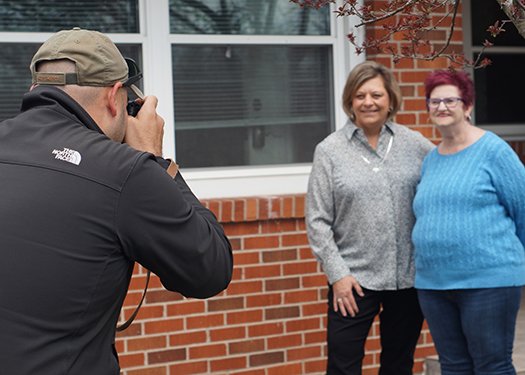
Jackie Reed (left) and Dorreen Rardin (right) pose for a portrait outside the future home of Caring Hearts and Hands of Columbia.
Nonprofits helping each other
In a chain reaction of moves, Caring Hearts and Hands of Columbia plans to take over the home that is currently being used by the St. Raymond’s Society after they move into the home now occupied by the Ronald McDonald House Charities of Mid-Missouri. RMH has plans to relocate closer to the University Hospital.
This is a story of three nonprofit organizations in Columbia that are all working together to serve the community.
“For every one of us, our end goal is to help the people we serve,” Mike Hentges, executive director of St. Raymond’s Society, said. “What you have here is three nonprofit organizations in one city that are collaborating to serve our community better.”
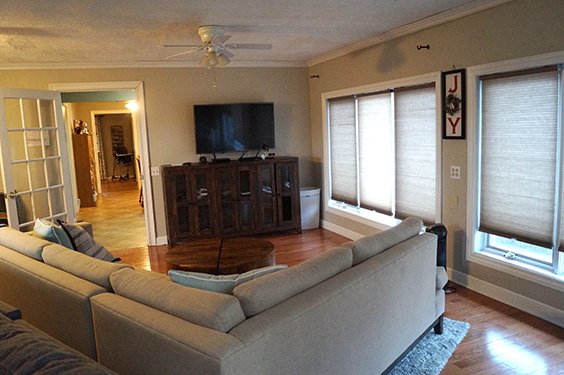
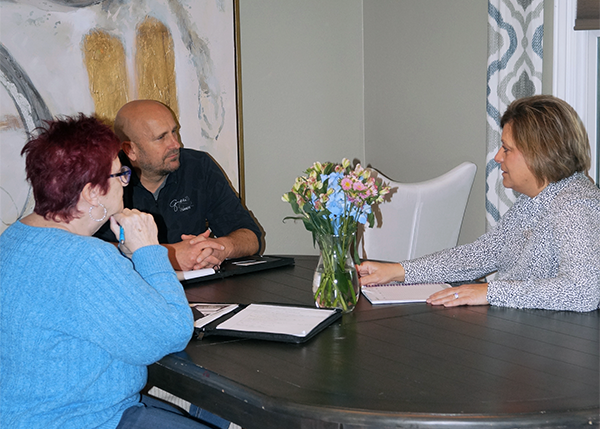
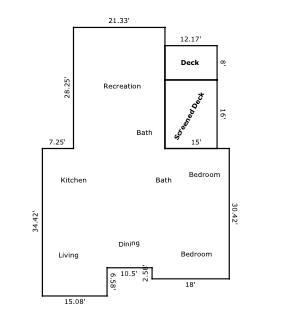
A large kitchen where Dorreen Rardin says “I’m going to bake cookies here every day!” A large living room will allow guests to easily visit with loved ones.Rardin and Reed sit in the dining room to discuss future plans for the house with Hentges of St. Raymond’s Society.
“The story of this house is incredible, really,” says Jackie Reed, co-founder for Caring Hearts and Hands of Columbia. “There’s a symmetry to this move. St. Raymond’s cares for pregnant women and new mothers. And we will care for community members and their families at the end of their lives. We are bookends. So, this house is a house filled with love. And that’s special.”
Future plans
While an exact date of operation isn’t set, the home will transition from SRS to CHHC in early 2023.
There are currently two rooms that can be used almost immediately once the Caring Hearts and Hands home opens.
Eventually, the basement level could be renovated to offer two additional guest rooms.
A dream realized
This is a crucial step toward fulfilling the CHHC mission.
“It has always been our goal to create a community-based home,” Dorreen Rardin, co-founder for CHHC, said. “A home is a special place. It is a place where people come together and create a community – whether it’s college roommates or more traditional nuclear families. We, very intentionally, want to provide a home and give comfort to those who are in their final days.”
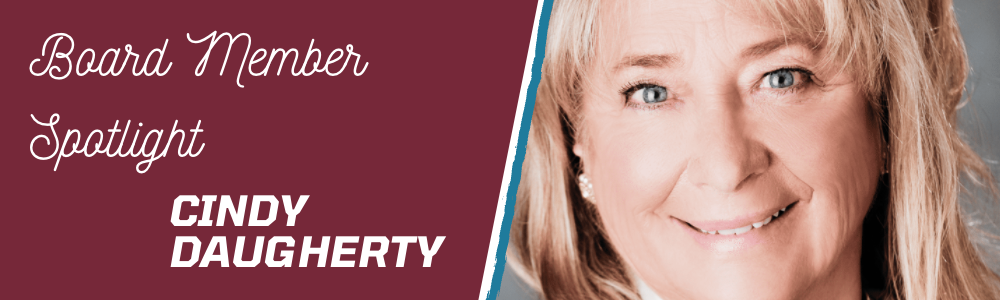
The work of Caring Hearts and Hands of Columbia isn’t possible without the help of volunteers. Cindy Daugherty is just one such volunteer. She current serves on the Board of Directors and works passionately to draw attention to the mission of Caring Hearts and Hands of Columbia.
How did you first hear about CHHC?
“I met Jackie [Reed] at Boone Health when my mother broke her hip. She was a palliative care nurse at Boone. Jackie told me about her idea for Caring Hearts and Hands, and I was immediately interested.”
How long have you been involved with CHHC?
“I have been helping with the mission for about nine months.”
What draws you to the organization’s mission?
“When my father insisted on dying at home, it was incredibly hard. No one is prepared for the issues that come with caring for someone in final days. I wish that this home had been open then.”
When you talk to others about CHHC, what resonates with others?
“I think anyone who has been a caregiver for someone can relate to the mission of Caring Hearts and Hands. My own children now relate after watching what I went through caring for my father. All generations will benefit from the CHHC home. While discussing death is hard, and no one wants to think about it, knowing that this resource will soon be available is an incredible comfort.”
Where are you from?
“I am born and raised in Columbia.”
Tell us about your family and/or those closest in your life.
“I have a son Scott, and daughter, Erin. I’m blessed with four grandchildren who I love spending as much time with as possible. I also have a sister, two brothers and lots of nieces and nephews. We get together often and always have. I’m also blessed with fantastic friends. Family and friends are central to my life.”
What do you hope to accomplish as a volunteer?
“While on the board, I would like to accomplish one thing: to open Columbia’s first alternative care home for those in their final days.”
How did you first hear about Caring Hearts and Hands of Columbia?
I first heard about CHHC through my work at New Chapter Coaching. I met with co-founder Doreen Rardin to see how we could be of service. After better understanding their needs and learning about the organization, mission, and their Board of Directors, I was hooked!
What draws you to the organization’s mission?
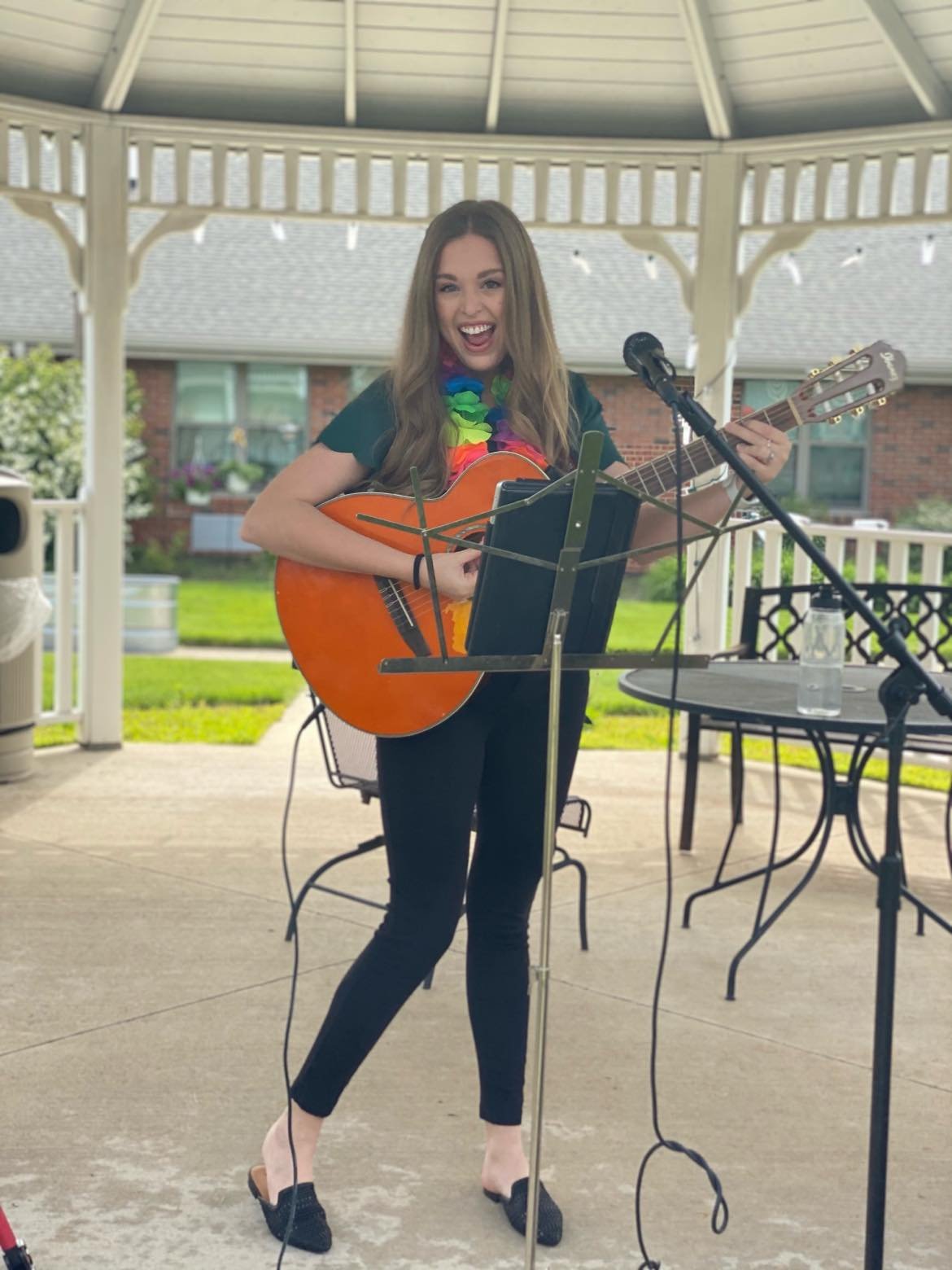
I am a board-certified music therapist and have a history of working with adults in hospice, senior living facilities, and hospitals. I’ve also had multiple experiences with loved ones at the end of their lives. With these experiences, I have a huge passion for helping those at end-of-life and making it as pleasant of an experience as possible.
When you talk to others about CHHC, what resonates with others?
We all experience this and most likely experience it with a family member or close friend. It is something everyone has in common. I believe we all can understand how important it is and how necessary it is to have an organization that is intentionally working to improve the end-of-life experience for all people despite income and ability.
What do you do? You’re a coach — but what kinds of things do you do?
I am a nonprofit consultant. I work with nonprofit organizations to develop a plan for their future that will leverage their strengths and result in maximum impact for the people they serve. I also work closely with teams and individuals to strengthen their culture, cultivate trust, improve employee engagement, integrate a strengths-based approach, and more.
Where are you from?
I am originally from Minnesota and have a slight northern accent to prove it if you listen closely. I was raised in Independence, MO, and received my undergraduate degree at Drury University. We currently live in Columbia, MO, and I am pursuing an MBA.
Tell me about your family.
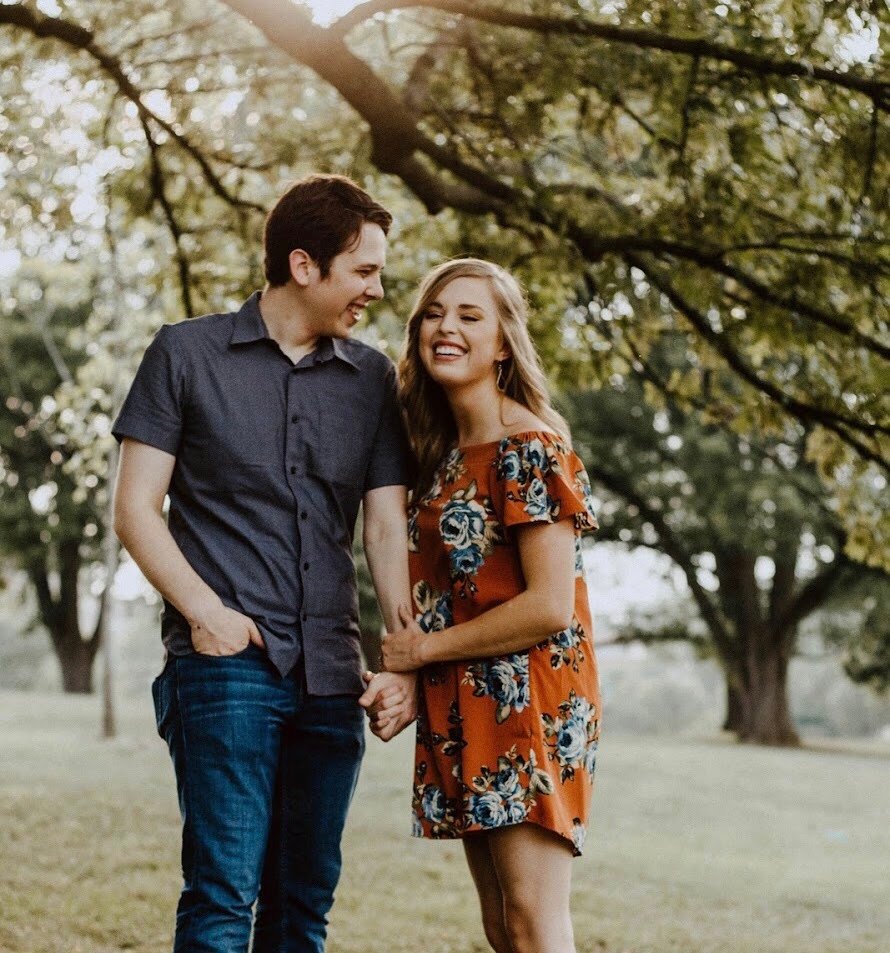
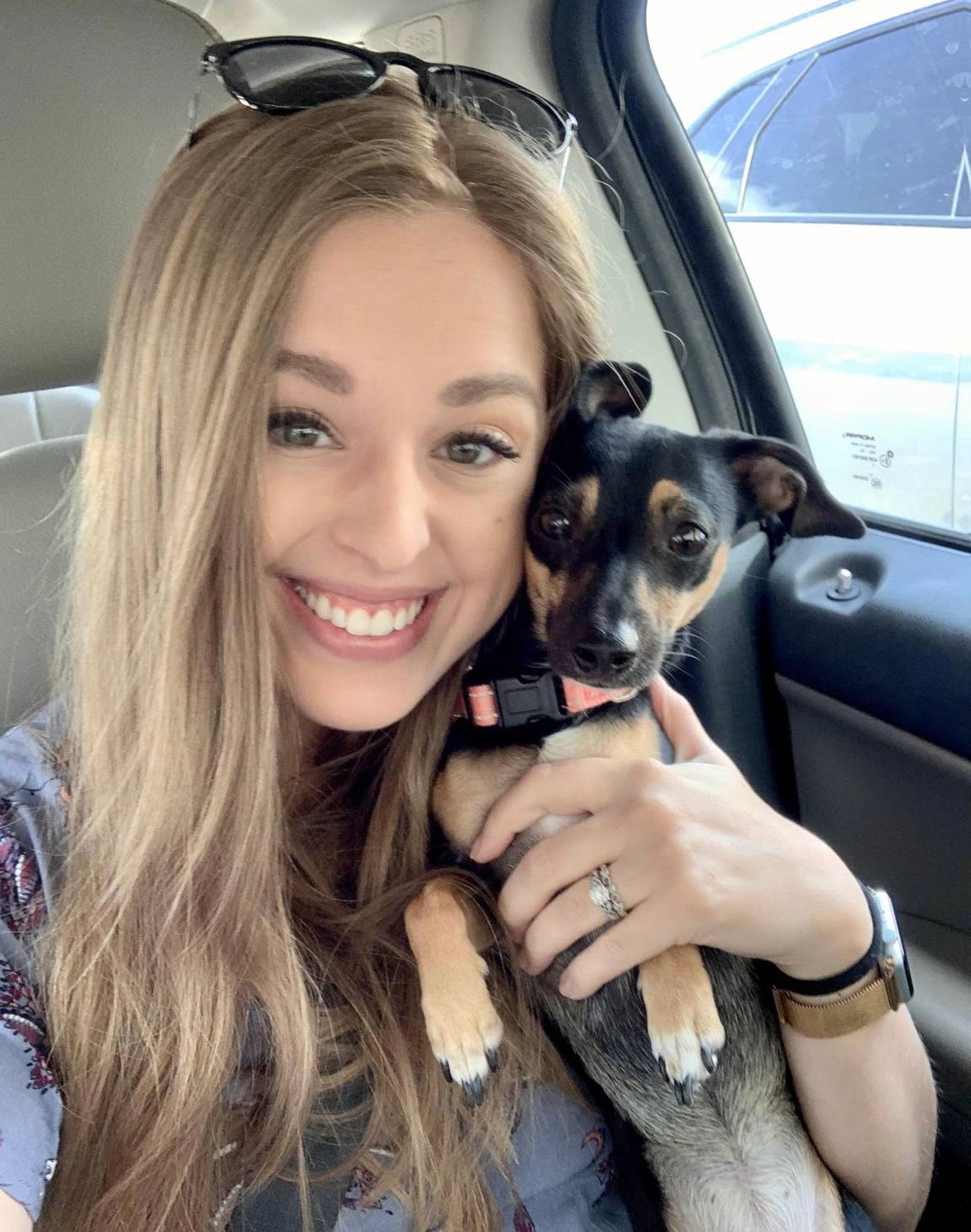
After seven years together, I married my high school sweetheart, Eric Swanson, in June of 2019. We met in music and theatre, both of which remain important parts of our lives. We live with our very spoiled dogs: Bagel the Beagle and Stella our seven-pound guard dog. We are close with our families who mostly all live in Independence, MO.
According to an article written by Dr. Karen Wyatt, a hospice and family physician, there are six reasons why the social model home hospice home is a much-needed solution for end-of-life care. Wyatt, an expert on the topic of end-of-life care, has written a book on the subject: “What Really Matters: 7 Lessons for Living from the Stories of the Dying.”
According to a study reported by AARP Public Policy Institute, there will be a severe shortage of family caregivers as the Baby Boom generation ages and faces the end-of-life. While there are currently seven potential family caregivers for every patient, this ratio is expected to drop to 3:1 by 2050.
2. Shortage of paid caregivers.
In addition, a study published in the Health Affairs journal in June indicates that “at least 2.5 million more long-term care workers will be needed to look after older Americans by 2030.”
3. Need for family respite.
The Institute of Medicine’s 2014 report Dying in America points to a current need for respite and support for family caregivers to help avoid burnout and resulting emergency hospitalizations. Social model hospice homes can provide respite care as well as terminal care, allowing for much-needed rest for exhausted caregivers.
4. Need for home renovation for safety and mobility.
The IOM report “Dying in America” also cites a “lack of publicly-funded programs for retrofitting homes for safety features and wheelchair accessibility. Social model hospice homes are already designed to meet safety and mobility standards and can eliminate the need for expensive renovations to family homes.”
5. Cultural barriers to hospice care.
Some of these barriers include a lack of cultural diversity in hospice staff, mistrust of the healthcare system, and worry about insurance coverage and cost of care. The community-based social model hospice home has the potential to overcome some of these barriers by utilizing volunteers and caregivers from the patient’s own cultural group and neighborhood, by functioning largely outside the health care system, and by eliminating financial concerns through unique funding streams.
6. Reduction in Medicare payments for hospice and home care.
Under the social model of care for the dying, there is no federal or state funding because these homes do not function as medical facilities. In many states, they are licensed under the Department of Social Services rather than the Department of Health. Social model hospice homes rely on foundations and grants, community fundraising, and contributions from individual donors for funding.
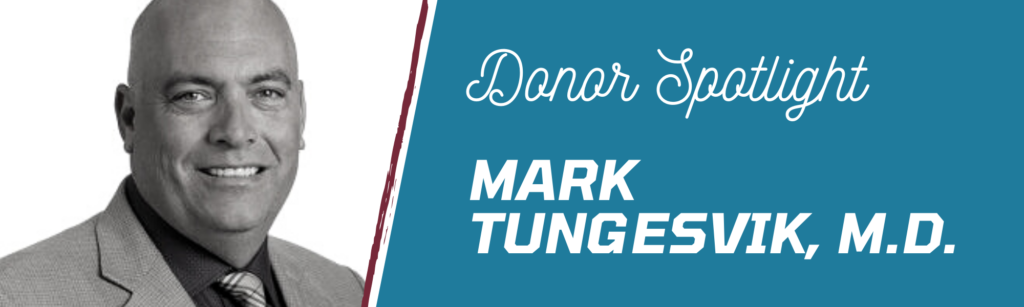
Dr. Mark Tungesvik, an oncologist with Missouri Cancer Associates, is no stranger to end-of-life care.
According to Tungesvik, oncology is one of the biggest referrers to palliative care where founders, Dorreen Rardin and Jackie Reed worked. He sees the need for Caring Hearts and Hands in our community.
“We will be treating people who are older and living alone. It’s not optimal, and as they get sicker, you’re in a pickle. For some, there’s not a lot of social support, and hospice can’t assist if the patient is alone. There are nursing homes, but that isn’t optimal. It could be a warm, loving place, but many patients don’t see it that way. I do think this is an unmet need.”
“There isn’t much small talk in the office,” Tungesvik says. “Once cancer patients have a diagnosis, their life changes. If it’s terminal, their perspective on life changes. And we form a real relationship. Working with the patients is the best part. That’s what I like, and that’s why I do it.”
But Tungesvik doesn’t stop at medical cancer treatments. He’s also nearing the end of a seven-year project, writing a trilogy of therapeutic fiction. This three-book series is meant to help those struggling more than just physically.
“Some people will have developed a dark worldview, and it’s hard to work out of that. So, I put together this series. It’s not just about providing for a person’s physical needs. They have to turn the corner emotionally and intellectually so they can have some hope. These books are about doing that.”
“I’ve been writing the Song of the Bear trilogy for nearly seven years, but I’m coming to the end of it. I’m going over what may be the final draft. I’ll be sending to a self-publisher soon.”
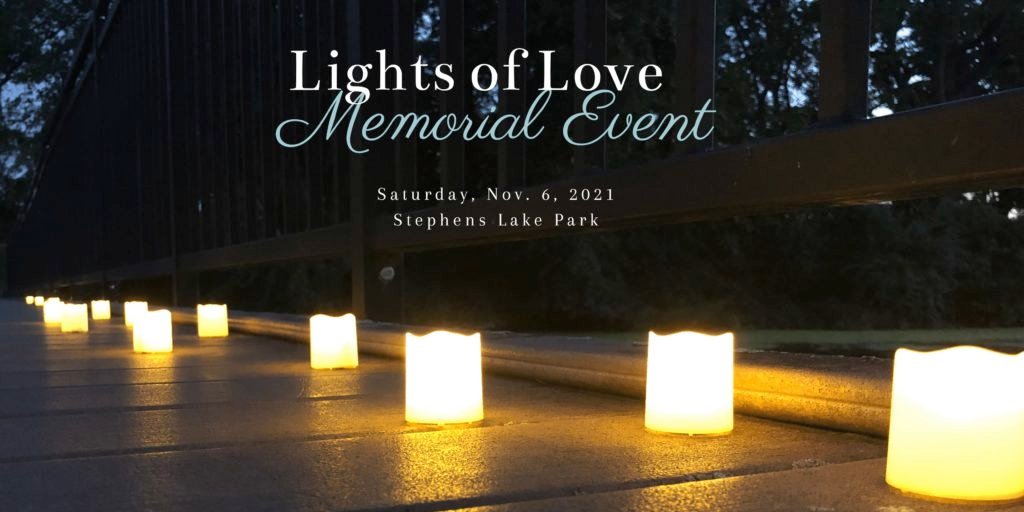
With donor support, we can light up the night at Stephens Lake Park on Nov. 6 as part of its inaugural fundraising event – Lights for Love: A Memorial Event.
This memorial event gives people an opportunity to purchase a luminary to honor their loved one and help raise funds to open a home in Columbia for those who are under hospice care, in the last month of life, and in need of caregiver support.
“We wanted to put together a fundraiser for the community that could be meaningful,” said Jackie Reed, treasurer, and co-founder for Caring Hearts and Hands of Columbia. “This is an opportunity to heal as a community after nearly two years of extremely difficult times for many of us.”
Community members can purchase a luminary to display at Stephens Lake Park on Nov. 6 at 5:30 p.m. Each luminary can be purchased for a minimum donation of $10.
The event will include music and will allow loved ones to spend time with others who have lost loved ones and remember their influence in our lives.
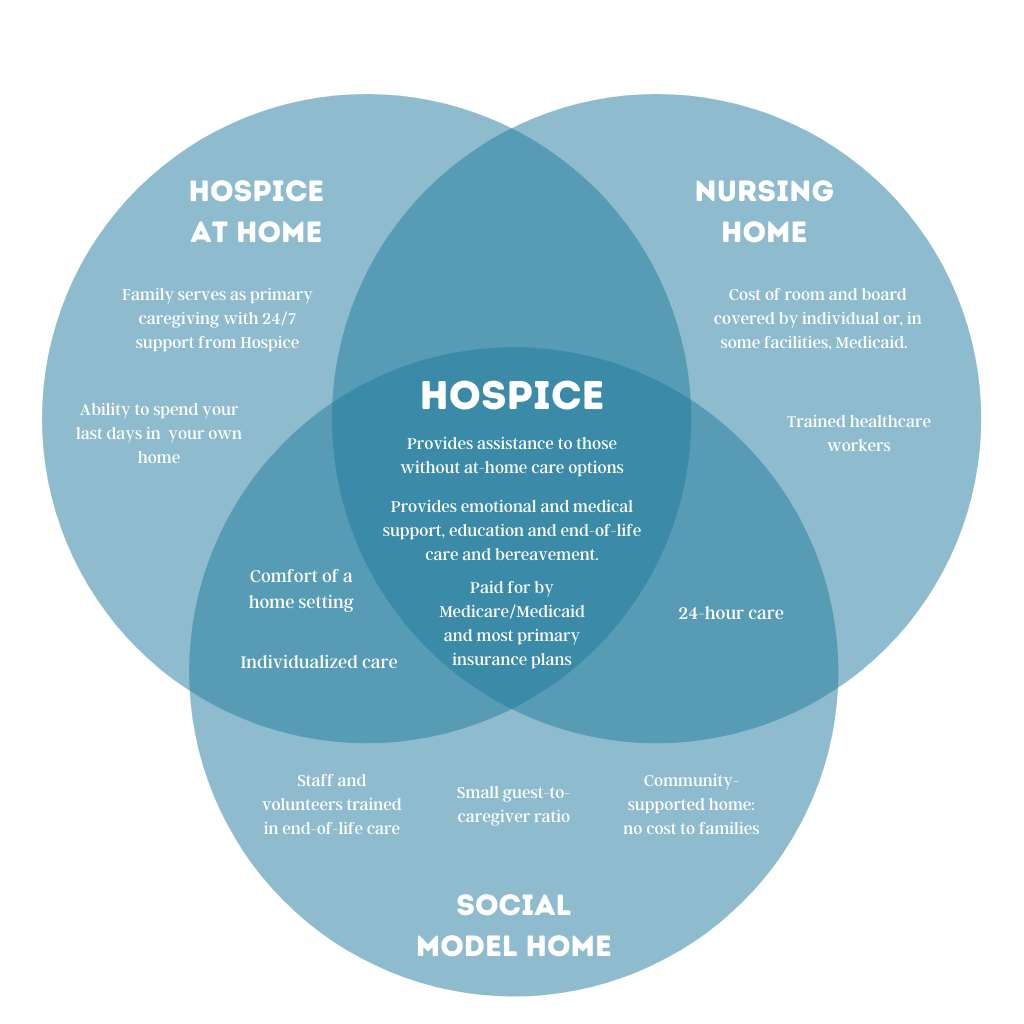
Understanding options for end-of-life care can be confusing. The following provides information about where Hospice at home, nursing home care, and social model home care – where they overlap and where they differ.
Caring Hearts and Hands is another step closer to opening a home for those in need of end-of-life care. The employees of Veterans United Home Loans, through their charitable non-profit Veterans United Foundation, have contributed $10,000 toward our goal.
“This donation will most certainly get us closer to opening our doors,” said Jackie Reed, Cofounder of Caring Hearts and Hands of Columbia. “I can’t wait to serve the people in Columbia who will be in need of our services.”
Caring Hearts and Hands was founded as a 501c3 nonprofit by Jackie Reed and Doreen Rardin, who worked together as palliative care nurses. They worked with people as they were at the end of their lives, and knew there were some who had no family or friends to care for them. And many were unable to pay for nursing care. They needed a safe and comforting place to spend their last days, without financial worries.
This gift is exciting for every board member and volunteer who has worked toward this goal, including Patrick Lee, board chair, who knows this gift puts them that much closer to their ultimate goal.
“When we open our first home in Columbia, we will be able to provide a place where the physical, emotional and spiritual needs of our guests and their families are met with compassion, love and respect,” said Lee.
Caring Hearts and Hands of Columbia is accepting donations toward its goal to open a home to care for those at the end of their lives. Any contribution is greatly appreciated.